United Kingdom · bid/no-bid · go/no-go
Bid/no-bid decision for UK SMEs (Contracts Finder and Find a Tender)
You have a named notice — from a portal alert, a colleague’s forward, or a Monday digest match. Before you hire a bid writer or lose a week in MultiQuote, run a ten-minute bid/no-bid decision. This guide is for Ltd and LLP SME directors in soft FM, cleaning and trades on roughly £10k–£250k lots. It teaches the gates we mark Pass, Fail or Unknown on a sourced memo — not how to write the bid.
Free weekly · £19/mo daily · £9.99 memo · £29.99 pack
What a bid/no-bid decision is (and is not)
A bid/no-bid decision — the same thing buyers call go/no-go — answers one question: is this named notice worth a week? It is not the ITT response. It is not a scorecard you fill in after you have already paid a writer.
Most generic checklists online assume you are still hunting for opportunities. You are past that. You have a URL. The job now is to kill bad bids early — before a £699–£5,000 invoice, before TUPE surprises in week two, before you discover you needed to be on a framework panel six months ago.
BidFit’s role stops at the decision document. If the verdict is Go, you still write the bid — in-house or hired. See how it works and the sample memos for what a finished verdict looks like.
Go / no-go tender UK — the ten-minute triage
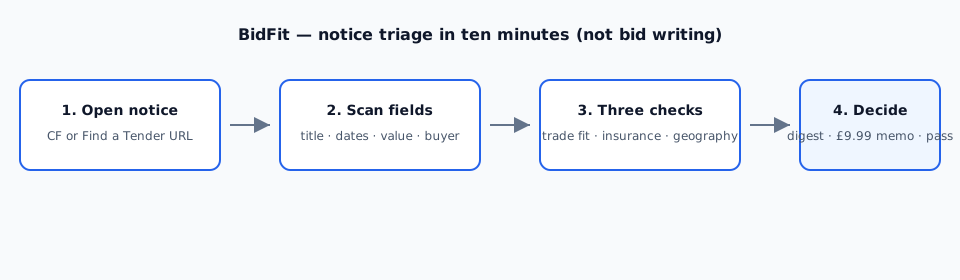
Before you open any checklist, spend ten minutes on the published notice (Contracts Finder HTML or Find a Tender UK4). You are not reading the pack yet. You are deciding whether the pack is worth downloading.
-
Clock. Note the deadline in BST. Count working days, not calendar optimism. If you cannot register on the buyer portal and stand up a credible response in that window, stop. The St Helier sample is a worked No-go on clock alone (34/100).
-
Trade and title. Does the CPV, description and buyer type match what you actually do? A “cleaning” title on a wider facilities lot is a common trap. See Soft FM Contracts Finder filters for keyword hygiene.
-
Geography. Where is the work? A notice that lists three counties is not the same as “anywhere in England”. If travel-to-work does not work, Fail — even when the value looks fine.
-
Hard no’s on the notice. Framework-only wording, stated accreditations, SME flag off, insurance minimums above your cover — any clear Fail ends the triage. Do not buy hope.
-
Unknowns. If the only things left are pack-only (turnover multiple, TUPE detail, scoring weights), you can stay on the free digest or buy a £9.99 public-notice memo. Upgrade to £29.99 only after you forward the ITT/SQ and those gates still matter.
If you do not yet have a named URL — only a vague “we should bid more public work” — start with portal alerts and the digest, not this page. See Contracts Finder + Find a Tender alerts without six tabs.
Bid/no-bid decision checklist (Pass / Fail / Unknown)
Use this table on one notice. Pass = clearly met from published text. Fail = clearly not met. Unknown = not stated on the notice; needs the pack or your broker — do not guess.
| Gate | What to check on the notice | Typical Pass | Typical Fail | Unknown when |
|---|---|---|---|---|
| Clock | Deadline date/time (BST), enquiry deadline if shown, portal registration lead time | Enough working days to register, site-visit if required, and draft | Deadline inside ~3 working days; enquiry window already closed with no extension | Pack silent on mandatory site visit — see Hull gutter sample |
| Trade fit | Title, description, CPV codes, contract type (services vs works) | Your core trade; scope matches kit and staff you have | Hospital LV board when you clean windows; grounds contract labelled “cleaning” | Scope lives in a PDF you have not opened |
| Geography | Region, site list, “must attend” locations | Sites inside your normal travel-to-work | Scotland lot for an England-only firm; multi-site spread you cannot resource | “Various locations” with no list on the notice |
| SME flag | SME suitable / SME-friendly wording on CF; FTS SME fields |
Flagged suitable; value band fits a small Ltd | Explicitly not SME suitable; value and scope clearly enterprise-scale | Flag absent — treat as Unknown, not automatic Pass |
| Framework-only | Framework reference, “call-off”, “suppliers on framework only”, DPS wording | Open procedure; no panel membership required | You are not on the named framework/DPS lot | Wording ambiguous — read framework call-offs vs open tenders |
| PL / insurance | Stated PL, EL, PI minimums on the notice | Your existing cover meets stated minimums | £10m PL on a £50k lot when you carry £2m | Not on notice — Unknown until pack; see PL and contract value guide |
| TUPE | TUPE mentioned in description or transfer wording | TUPE in scope and you price it (or it is not mentioned) | TUPE is a hard no for your firm regardless of price | “May apply” with no headcount — Unknown on £9.99 memo |
| Turnover | Minimum turnover, financial standing, accounts years — see turnover on Contracts Finder notices | Your filed turnover clearly above the stated floor | 2× contract value rule would exclude you and the notice states it | Not on notice — Unknown; £29.99 pack memo if you proceed |
| Incumbent | Last award notice, named supplier, renewal language — see find incumbent on Contracts Finder | No award found; open market; or you are the incumbent | Strong incumbent + short clock + specialist scope you do not hold | Award data missing — memo says “not found in public award data” |
One Fail on a gate you cannot fix in the time left is usually a No-go. Multiple Unknowns are not a Yes — they are a reason to open the pack carefully or buy a memo, not a reason to call a writer.
How the samples score these gates
Real dated verdicts (public data only; packs not opened unless stated):
- Bedford College windows — Go 73/100. Open, SME-flagged, workable clock; insurance and turnover Unknown on the notice.
- St Helier LV board — No-go 34/100. Trade and environment Fail for a typical SME; clock Fail (two working days).
- Hull College gutter cleaning — Go 60/100. Geography and trade Pass for a Humber firm; short clock; pack gates Unknown.
- Hertford festive lights — Go 54 / No-go 18 depending on HERS and CFA registration (published hard gate).
Full index: sample memos. Trade-specific pitfalls: window cleaning sector page.
Digest vs memo — where this checklist ends
The free weekly digest (up to three matches) and £19/month daily upgrade shorten discovery. They are not a bid/no-bid decision. Most Monday matches die in the ten-minute triage above with no memo.
Buy the £9.99 public-notice memo when:
- The notice survived your triage and someone will ask “why are we bidding this?”
- You want a sourced fit score and pass/fail table before bid-writing spend
- You need incumbent / last-award work done on one URL
Buy £29.99 only when you have the ITT/SQ pack and gates that were Unknown on the notice must be filled — insurance multiples, turnover, TUPE headcount, scoring. It is still not a written bid.
Product detail: when a notice match needs a memo. Order: order form.
Not another alert aggregator
Several products email tender notices at about £19/month for daily cadence. That solves inbox volume. It does not produce a sourced Go / No-go on a named notice, cap your weekly list to three matches, or mark pack-only gates Unknown instead of guessing. BidFit is discovery plus an optional decision document — not a dashboard of every portal.
What BidFit will not do
- Not bid writing. No draft responses, no SQ completion, no portal submission.
- Not legal, TUPE or insurance advice. We flag what the notice says; you talk to your advisers.
- Not a replacement for gov.uk. Keep official saved searches as source of truth.
Questions
What is a bid/no-bid decision on a UK public tender?
A bid/no-bid decision (go/no-go) is whether a named notice is worth a week of director time or a bid-writer invoice before you download the ITT pack. It is not the written bid itself. You run published gates — clock, trade fit, geography, SME flag, framework-only wording, insurance, TUPE, turnover, incumbent — and mark each Pass, Fail or Unknown.
How is a go/no-go tender decision different from a tender alert?
An alert or digest match tells you a notice exists and roughly fits your trade and region. A go/no-go decision scores that named notice against your hard gates and produces a sourced verdict. BidFit’s free weekly or £19 daily digest is discovery; the optional £9.99 or £29.99 memo is the decision document. Neither writes the bid.
What should be on a bid/no-bid decision checklist?
At minimum: deadline clock; trade and CPV fit; geography and travel-to-work; SME suitability flag; framework or call-off only wording; stated public liability and insurance minimums; TUPE mention; turnover or financial-standing thresholds; incumbent or last-award snapshot. Mark each Pass if you clearly meet it on the published notice, Fail if you clearly do not, Unknown if the gate lives only in the ITT/SQ pack.
When should I buy a £9.99 memo instead of deciding myself?
Buy the £9.99 public-notice memo when the notice survived your ten-minute triage and the cost of a wrong bid is real — typically a £699–£5,000 writer invoice or a week of director time. You want a sourced fit score, pass/fail table and plain Go or No-go before you open the pack. Buy £29.99 only when pack-only gates must be filled from the ITT/SQ you forward.
Does BidFit write bids or give legal, TUPE or insurance advice?
No. BidFit emails profile-matched notices from Contracts Finder and Find a Tender and, when you ask, writes a sourced Go/No-go memo. We do not draft responses, complete SQs, register you on buyer portals, or replace gov.uk. Memos are informational decision documents, not legal, employment-law or insurance advice.
More guides
All BidFit guides: /guides/. Notice triage: how to read a tender notice in ten minutes. Incumbent lookup: find incumbent / last award on Contracts Finder. Turnover gates: turnover requirements on notices. TUPE wording: TUPE wording cues on Contracts Finder. Portal setup: Contracts Finder + Find a Tender alerts. Filters: Soft FM Contracts Finder filters. Framework vs open: framework call-offs vs open tenders. Insurance gates: PL and contract value. Memo vs digest: when a match needs a memo.
Start with discovery, decide on one notice
Take the free weekly list. When a named notice survives triage, order a £9.99 memo — or run the checklist yourself and move on.